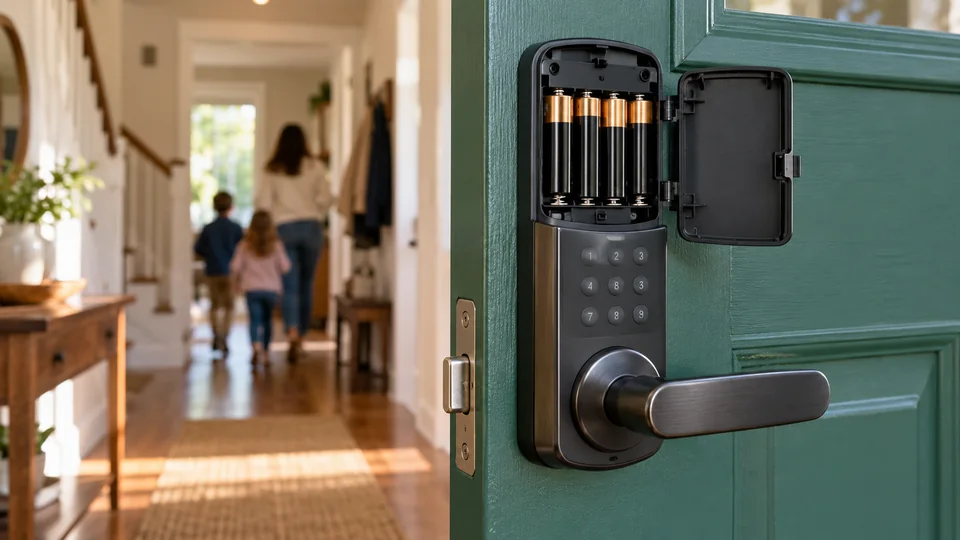
Battery life is easy to overlook until a lock starts warning at the worst possible moment. A front-door deadbolt that needs fresh batteries every few months can become a nuisance, while a lock with a longer stated runtime may reduce maintenance without giving up keypad, fingerprint, app, or physical-key access. The right choice depends on more than a month count. Door compatibility, emergency entry, outdoor exposure, connectivity, and the way people actually enter the property all matter.
There is also a difference between a complete smart lock and a battery accessory for an existing system. A rechargeable pack may be useful for preventing downtime, but it cannot replace a compatible lock. Likewise, a keypad lock, fingerprint deadbolt, electronic lever, and padlock serve different doors and access routines. A model intended for an interior office door should not automatically be treated as suitable for an exposed front entrance, and a built-in Wi-Fi lock may use more power than a simpler keypad model.
Quick Answer
Best overall: DESLOC B200 Fingerprint Smart Door Lock offers see access methods below. See connection requirements below.
Best for weather-exposed keypad entry: Veise RZ-A Electronic Keypad Deadbolt offers see access methods below. See connection requirements below.
Best for longest stated battery runtime: Kwikset SmartCode 955 offers see access methods below. See connection requirements below.
Best for smart lever doors: Aqara Smart Lock U300 offers fingerprint, pin, apple home key, compatible nfc and app. Bluetooth and native Matter over Thread; compatible controller and Thread border router.
Best Smart Locks with Long Battery Life Comparison Table
| Product | Best For | Battery Approach | Primary Access Methods |
|---|---|---|---|
| DESLOC B200 Fingerprint Smart Door Lock | Flexible front-door access | 4 AA, up to 12 months | Fingerprint, PIN, app, key, optional gateway voice control |
| Veise RZ-A Electronic Keypad Deadbolt | Weather-exposed keypad entry | 4 AA, up to 12 months | PIN, one-time code, physical key |
| Kwikset SmartCode 955 | High-traffic lever doors | One 9V battery, up to 3 years | Keypad, physical key |
| ThorBolt MD1 Fingerprint Door Knob | Interior rooms and offices | 4 AA, up to 1 year | Fingerprint, keypad, physical key |
| Zylenor Keyless Entry Door Lock | Wi-Fi keypad access | 8 AA, up to 10 months | PIN, app, Wi-Fi, voice, physical key |
| Lokko Smart Fingerprint Padlock | Lockers, sheds, and gates | Rechargeable, up to 6 months daily use | Fingerprint, Bluetooth, physical key |
| eufy Smart Lock E31 | Long rechargeable runtime | 10,000 mAh rechargeable battery; up to 14 months at 10 unlocks a day | Fingerprint, PIN, app and physical key |
| Veise VE017 | Flexible shared access | Four AA alkaline batteries; about 12 months depending on use | Fingerprint, PIN, fob, app and physical key |
| Aqara Smart Lock U300 | Smart lever doors | Up to 10 months on four AA alkaline batteries; USB-C emergency power | Fingerprint, PIN, Apple Home Key, compatible NFC and app |
The detailed reviews explain where each option fits, which battery claims matter, and what to verify before ordering.
1. DESLOC B200 Fingerprint Smart Door Lock — Best Overall

The DESLOC B200 earns the top position because its battery claim is paired with a broad set of entry methods. The listing states that four AA batteries can provide up to 12 months of use, while a low-battery indicator and USB-C emergency power port provide a fallback when the batteries are depleted. That combination matters at a front door, where a warning light and a power-bank option are more useful than discovering a dead lock after dark.
Fingerprint access is the headline feature, but the B200 is more flexible than a biometric-only design. It supports PIN codes, app control, eKeys, key fobs, and physical keys. The TTLock app can manage scheduled or temporary codes through Bluetooth, while Alexa and Google Assistant voice control require the separately sold G2 Gateway. That distinction is easy to miss. The lock offers several access paths, but remote or voice features depend on the relevant setup.
Pros
- Stated battery life of up to 12 months from four AA batteries.
- Fingerprint, PIN, app, eKey, key fob, and physical-key entry options.
- USB-C emergency power port and low-battery indicator.
- Supports scheduled and temporary access codes through the TTLock app.
- IP54-rated water resistance and a stated operating range from -22°F to 158°F.
Cons
- The G2 Gateway is required and sold separately for voice control and expanded connectivity.
- Battery runtime will vary with usage, and the listing does not provide a single guaranteed operating condition.
This is the strongest match for a household that wants long battery intervals without committing to one entry method. Fingerprint access can be convenient for daily arrivals, while a PIN or physical key gives visitors and emergencies a separate route. Buyers should still confirm that their existing door preparation matches the lock because “most standard US doors” does not establish compatibility with every door.
To buy this product, click here.
2. Veise RZ-A Electronic Keypad Deadbolt — Best for Weather-Exposed Keypad Entry

The Veise RZ-A takes a simpler route to long battery life. Its four AA batteries are listed for up to 12 months of daily use, and the backlit keypad provides a low-battery alert before the power runs out. There is no fingerprint sensor or app-driven access in the product description, but that narrower feature set may appeal to someone who wants dependable code entry without managing biometric enrollment or a connected account.
This deadbolt is also one of the better choices for exposed residential use. The listing identifies IP54 weather resistance, an operating range from -35°F to 160°F, and compatibility with standard US doors from 1-3/8 to 2 inches thick. It includes two spare keys, supports 20 permanent codes plus one-time codes, and can lock automatically after a selectable delay from 10 to 99 seconds. The door handle is not included, so the purchase is for the deadbolt portion rather than a complete handle set.
Pros
- Stated 12-month battery life from four AA batteries.
- Supports 20 permanent codes and one-time guest codes.
- Includes two spare keys for physical backup access.
- IP54 rating and stated operation from -35°F to 160°F.
- Offers automatic locking, one-touch locking, silent mode, and vacation mode.
Cons
- It is a keypad deadbolt rather than a fingerprint or app-controlled smart lock.
- The door handle is not included, and batteries must be purchased separately.
The RZ-A suits a front door where code sharing and weather exposure matter more than smartphone control. One-time codes are useful for a cleaner guest handoff than sharing a permanent family code, while vacation mode can restrict normal codes during an absence. Check the door thickness and existing lock preparation before ordering, particularly if the current hardware uses an unusual configuration.
To buy this product, click here.
3. Kwikset SmartCode 955 — Best for Longest Stated Battery Runtime

The SmartCode 955 stands apart through its stated three-year battery life from a single 9V battery. That claim is longer than the other complete locks here, although real runtime will depend on use and conditions. The model is a keypad lever rather than a deadbolt, so it belongs on a compatible lever-door installation rather than being treated as a universal replacement for a front-door deadbolt.
Its light-commercial positioning gives the 955 a useful role in busy interior or controlled-access locations. The listing describes testing to 500,000 cycles, Grade 2 BHMA certification for security, durability, and finish, and support for up to 30 user codes, one one-time code, and one programming code. Auto-lock and passage modes let the same hardware work differently in a private office, shared room, or public restroom. A physical key cylinder also supports re-keying with KW1 keys.
Pros
- Stated battery life of at least three years from one included 9V battery.
- Lever configuration suits compatible high-traffic doors.
- Supports up to 30 user codes and one one-time code.
- Includes auto-lock and passage modes.
- Provides illuminated keypad entry and a physical key cylinder.
Cons
- It is a keypad lever and may not replace a standard deadbolt installation.
- The product description does not identify smartphone, Wi-Fi, Bluetooth, or voice control.
Choose this lock when battery changes are the main concern and the door needs a lever assembly. The physical keypad and one-time code are practical for shared access, while the stated cycle testing fits busier locations better than a typical bedroom-only lock. Buyers should verify lever-door preparation, handing, and other installation details before assuming it will fit an existing opening.
To buy this product, click here.
4. ThorBolt MD1 Fingerprint Door Knob Lock — Best for Interior Fingerprint Access

For a bedroom, office, pantry, or other interior room, the ThorBolt MD1 combines biometric entry with a keypad and physical key. Its listing states that four AA alkaline batteries can provide up to one year of operation, with a USB-C port for emergency power and backup keys if the batteries run out. The batteries are not included, so they need to be added before installation.
The access capacity is unusually generous for an interior door lock. The MD1 can manage up to 100 fingerprints and 100 passcodes, with passage and silent modes available through the admin settings. Automatic locking after five seconds helps in a room where the door should secure itself after entry, while anti-peep keypad input allows random numbers to be entered around the correct code. The product information describes a four-step screwdriver installation for most US doors, but exact fit still depends on the door and existing hardware.
Pros
- Stated battery life of up to one year from four AA batteries.
- Supports up to 100 fingerprints and 100 passcodes.
- Offers fingerprint, keypad, physical-key, and USB-C emergency-power access.
- Five-second automatic locking can secure interior rooms without a manual turn.
- Includes anti-peep input, passage mode, and silent mode.
Cons
- The product is aimed at interior door applications rather than outdoor front-door use.
- AA batteries are not included, and the product description does not identify app or remote access.
The MD1 is a sensible fit for shared offices, dorm rooms, bedrooms, and storage areas where many authorized users may need access. Its fingerprint capacity reduces the need to distribute codes, while the keypad and key provide alternatives when a finger is wet or unavailable. It is less suitable for buyers who specifically need Wi-Fi management or outdoor installation.
To buy this product, click here.
5. Zylenor Keyless Entry Door Lock — Best for Built-In Wi-Fi Access

The Zylenor uses eight AA batteries and lists up to 10 months of battery life. Eight cells may mean more batteries to replace, but the design is aimed at users who want built-in Wi-Fi, app control, temporary passwords, and voice access through Google Assistant or Alexa. A USB-C port provides emergency power, while a mechanical key remains available for emergency entry.
Its access-management features go beyond a basic keypad. The listing describes permanent and temporary passwords, auto-lock and timed-lock modes, party and holiday modes, and an anti-hijacking function that can trigger an alarm and send a notification when a designated code is used. Those features sound useful for controlled access, but the product description does not identify the exact remote-management limits, subscription terms, or supported app ecosystem. The lock is described as a US-standard deadbolt for doors with a stated thickness range of 35 to 50, with additional dimensions listed in the product information.
Pros
- Built-in Wi-Fi, app control, and voice unlocking are documented.
- Stated battery life reaches up to 10 months from eight AA batteries.
- Supports permanent and temporary passwords.
- Includes USB-C emergency power and mechanical-key backup.
- Offers auto-lock, timed lock, holiday mode, and an anti-hijacking alert function.
Cons
- Eight AA batteries create a larger replacement set than the four-AA designs in this comparison.
- The listing does not clearly identify detailed remote-management limits or subscription requirements.
This model fits a front door where app and voice access matter more than the longest possible battery interval. The ten-month claim is still substantial, but Wi-Fi activity can make power planning more important than with a keypad-only lock. Confirm the stated door dimensions and understand how the app handles temporary credentials before relying on it for guests or managed access.
To buy this product, click here.
6. Lokko Smart Fingerprint Padlock — Best for Lockers and Storage Areas

The Lokko is a different type of electronic lock from the deadbolts and levers above. Its 6mm steel shackle is intended for gym lockers, school and workplace lockers, fences, and storage sheds. A built-in 350mAh rechargeable battery is listed for up to six months of daily use or 12 months on standby, and USB-C charging avoids the need to keep disposable cells on hand.
Fingerprint access is the main attraction, with Bluetooth unlocking available as another option. The Tuya app can manage users, show unlock records, and create temporary passcodes for other people. A backup key is included for a malfunction or depleted battery. Those features make the padlock useful for shared storage, but its shackle format means it should not be confused with a door lock. Outdoor suitability also depends on where the padlock is mounted and how much moisture it encounters.
Pros
- Rechargeable 350mAh battery with a stated six-month daily-use runtime.
- Fingerprint and Bluetooth unlocking reduce reliance on daily key use.
- 6mm steel shackle suits lockers, fences, and storage applications.
- Tuya app supports user management, unlock records, and temporary passcodes.
- Includes USB-C charging and a physical backup key.
Cons
- It is a padlock, not a replacement for a residential deadbolt or lever lock.
- Rechargeable operation requires periodic charging, and the listing does not specify an outdoor ingress rating.
The Lokko makes sense for a locker or shed where fingerprint access is convenient and a physical key would be easy to lose. It is also one of the few choices here with a rechargeable battery as part of the lock itself. Buyers should match the shackle diameter and clearance to the hasp before ordering, and should avoid assuming that general outdoor use means unrestricted weather exposure.
To buy this product, click here.
7. eufy Security Smart Lock E31 — Best for Rechargeable Power

The E31 centers its design around a large rechargeable battery and a familiar set of entry methods. Its 10,000mAh battery is listed for up to 14 months under a stated usage pattern of 10 unlocks per day, although actual runtime will vary with use. A low-battery alert appears at 20 percent, and power-save mode may extend operation for up to another month. If the battery is depleted, a portable charger can provide a way to unlock the lock, which is different from ordinary recharging.
Fingerprint, keypad, app, physical-key, and voice entry cover the main daily scenarios. The listing describes support for Matter, Apple Home, Google Home, Alexa, and SmartThings, with remote control through HomePod or other hubs. It also claims installation in about 15 minutes without drilling, but the available information does not list every door measurement or deadbolt configuration. That makes a careful hardware check worthwhile before treating the installation claim as universal.
Pros
- Uses a 10,000mAh rechargeable battery with a listed runtime of up to 14 months under stated usage.
- Supports fingerprint, app, keypad, physical-key, and voice entry.
- Works with Matter, Apple Home, Google Home, Alexa, and SmartThings according to the listing.
- Provides low-battery alerts and portable-charger access if the battery is depleted.
- Includes auto-lock, access management, notifications, and event logs through supported apps and hubs.
Cons
- The portable charger provides emergency access but does not replace normal battery charging.
- The listing does not provide complete door-preparation measurements for every installation.
The E31 is appealing for people who would rather recharge a battery than keep spare AA cells nearby. Its entry methods also work well for a household where some users prefer fingerprints and others want a key or keypad. Buyers should verify the existing deadbolt and the hub arrangement for remote Matter features, since the published information does not establish every platform function.
For a low-maintenance setup, choose the connection mode you actually need and keep the bolt moving freely. Frequent use, cold weather and a binding latch can shorten the time between battery changes or charges.
To buy this product, click here.
8. Veise VE017 — Best for Multi-User Access Control

The Veise VE017 is aimed at households and properties where access permissions change regularly. Its listing describes permanent, one-time, duration, and recurring codes, along with the ability to add, rename, pause, or delete users through the KK Home app. Activity logs show who accessed the property and when. That is more useful than simply having a keypad, especially if a cleaner, sitter, tenant, or family member needs a credential that should not remain active forever.
Fingerprint entry, app access, fob cards, passcodes, code sharing, a mechanical key, and optional voice control are listed among its eight access methods. Remote locking and unlocking require the separately sold Veise G1 gateway, so the lock’s nearby app operation and its away-from-home control should be treated as different capabilities. The product information lists support for 1.5- or 2.125-inch lock holes and door thicknesses from 1.375 to 2 inches, plus IP55 protection and a USB-C emergency port. The listing also identifies a one-year warranty with a possible extension after registration.
Pros
- Supports one-time, duration, permanent, and recurring access codes.
- Provides activity logs and user-permission controls through the app.
- Offers fingerprint, fob, code, app, and mechanical-key entry.
- Lists specific lock-hole and door-thickness compatibility ranges.
- Includes auto-lock timing, low-battery alerts, and a USB-C emergency port.
Cons
- Remote lock control requires the separately sold Veise G1 gateway.
- The product description does not explicitly identify Android compatibility for the KK Home app.
This is a sensible choice for access management rather than a minimal phone-operated lock. The code types and permission controls can help keep temporary access organized, while the mechanical key provides a separate fallback. Android users should verify the current KK Home app requirements before purchase, especially if smartphone control is central to the decision. Also budget space and connectivity for the G1 gateway if remote access away from the door is required.
For a low-maintenance setup, choose the connection mode you actually need and keep the bolt moving freely. Frequent use, cold weather and a binding latch can shorten the time between battery changes or charges.
To buy this product, click here.
9. Aqara Smart Lock with Handle U300, Black — Best Smart Lever Lock

A deadbolt is the wrong shape for a door that needs a lever assembly, and that is where the U300 becomes relevant. This model combines a smart lever with Apple Home Key, a touchscreen keypad, fingerprint entry, Siri access, and Matter over Thread. The listing describes a 160 by 160 pixel fingerprint sensor and storage for up to 25 fingerprints, giving the lever a clear household-access focus.
Power comes from four AA alkaline batteries, with a claimed runtime of up to 10 months. Aqara specifically says alkaline batteries are required, so substituting another battery chemistry is not a sensible shortcut. Dual USB-C ports provide backup power during an emergency. Apple features require a Thread-enabled Apple hub, while Matter functions require a suitable controller for the chosen ecosystem.
Pros
- Uses a genuine smart lever configuration.
- Supports Apple Home Key, fingerprint, keypad, and Siri entry.
- Offers Matter over Thread for multiple smart home ecosystems.
- Provides dual USB-C emergency power ports.
- Stores fingerprint data locally with AES encryption according to the listing.
Cons
- Requires alkaline batteries for the specified operation.
- Apple features require a compatible Thread-enabled Apple hub.
The U300 is the natural pick for a compatible lever-door installation, but the product category itself makes door preparation especially important. A shopper replacing a deadbolt should stay with a deadbolt model instead. Within its intended format, the U300 balances several entry methods with long claimed battery life and a useful emergency-power arrangement.
For a low-maintenance setup, choose the connection mode you actually need and keep the bolt moving freely. Frequent use, cold weather and a binding latch can shorten the time between battery changes or charges.
To buy this product, click here.
Buying Guide
Compare active use, not standby alone
A standby estimate describes a different workload from daily locking and unlocking. Account for the number of users, motor cycles, Wi-Fi activity and visitor-code traffic before setting a service schedule.
Choose replaceable or rechargeable power
AA-powered locks are easy to service with spare cells; rechargeable models reduce routine cell replacement. Use the specified chemistry and keep a charging or replacement plan that does not leave the door inaccessible.
Keep the bolt aligned
A binding bolt makes the motor work harder. Adjust the strike and hinges, protect the interior assembly from cold or moisture and respond promptly to battery warnings.
FAQ
How long will the battery last in everyday use?
Use the runtime in the comparison table as a starting estimate, then adjust the service interval to door traffic, temperature, connection settings and battery condition. Standby figures are not the same as daily motor use.
Will remote access work without extra hardware?
Use the connection path in the comparison table. Built-in Wi-Fi, Bluetooth, a proprietary hub and Matter controllers have different requirements. Local PIN, fingerprint or key entry does not make a Bluetooth-only lock independently accessible over the internet.
What should I do before giving a guest access?
Set up a separate credential using the lock’s supported options, confirm it opens the door, and remove or expire it after use. Keep the backup entry method available to someone you trust.
How can I avoid a battery-related lockout?
Act on low-battery alerts, use the specified cells or charging method, and keep the mechanical key or supported emergency-power source outside the locked area. Confirm the backup procedure before depending on it.
Final Verdict
DESLOC B200 Fingerprint Smart Door Lock is the first option to consider for overall. Choose Veise RZ-A Electronic Keypad Deadbolt when weather-exposed keypad entry is the priority, or compare Aqara Smart Lock U300 for smart lever doors.
For a low-maintenance setup, choose the connection mode you actually need and keep the bolt moving freely. Frequent use, cold weather and a binding latch can shorten the time between battery changes or charges.
